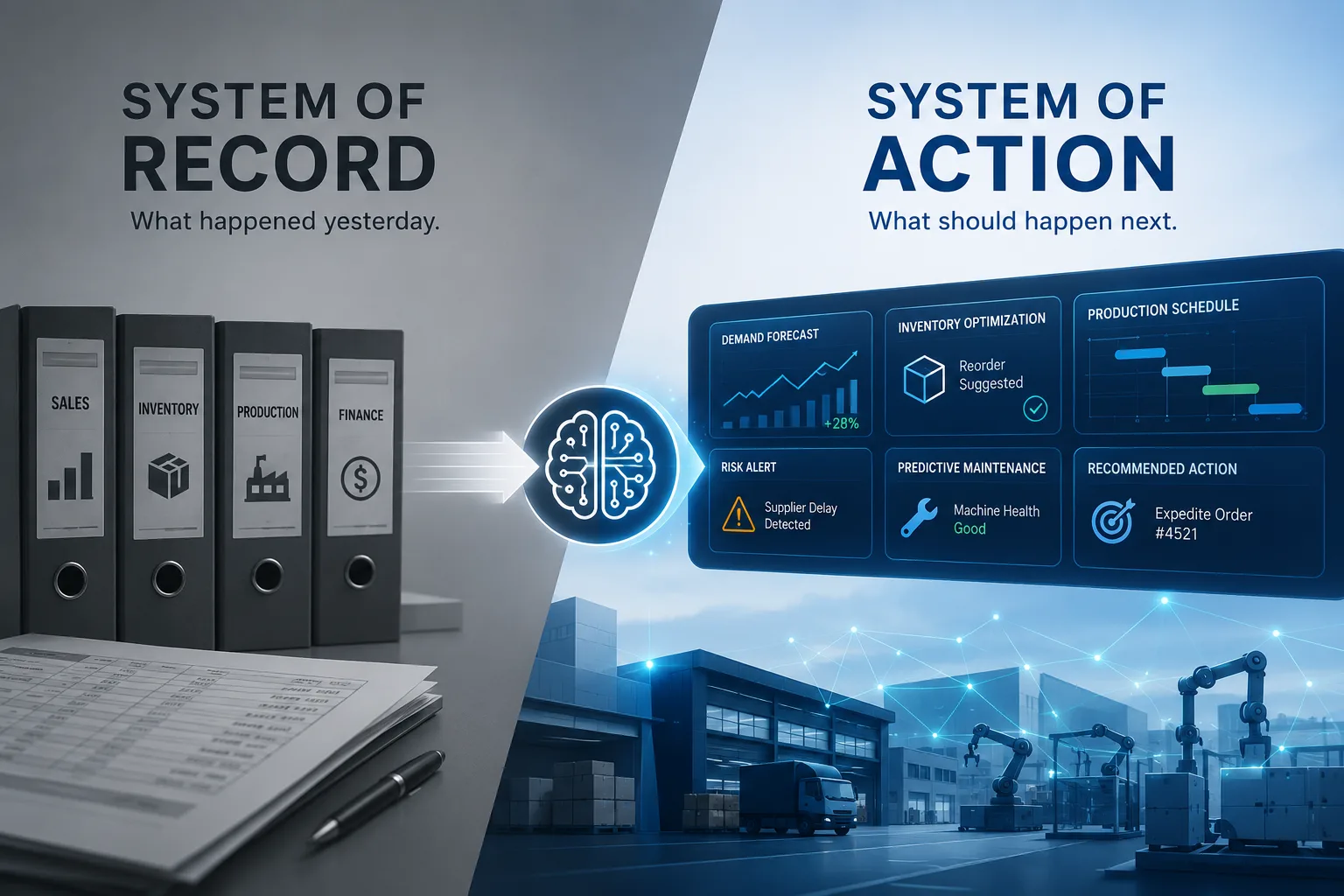
The Core Difference: System of Record vs. System of Action
For decades, Enterprise Resource Planning (ERP) systems have been the central nervous system for manufacturing operations, meticulously recording transactions for finance, inventory, and production. Traditional ERPs are fundamentally passive systems of record that depend on human input and pre-defined rules. They tell you what happened yesterday. This model is showing its limits in an era of volatile supply chains and increasing customer demand for customization.
Enter the AI-native ERP. The distinction isn't just a marketing label or a chatbot feature layered on top of old architecture. The fundamental difference is a shift from a passive system of record to an active, intelligent system of action. An AI ERP doesn't just store data—it analyzes, predicts, and recommends the next best action, transforming the ERP into a proactive partner in your operations.
This post explores the tangible ways this shift from rule-based to AI-driven ERP is reshaping manufacturing and supply chain management.
Rethinking Demand Forecasting and Inventory
One of the most significant impacts of AI in ERP is on demand forecasting and inventory management. Traditional ERPs rely on historical sales data and static statistical models, which struggle to keep up with market volatility.
From Historical Averages to Predictive Analytics
Traditional systems look backward to guess what's next. This often leads to inaccurate forecasts, resulting in costly stockouts or excess inventory. An AI-driven ERP, however, leverages machine learning to analyze vast and varied datasets in real time. It can incorporate not just your sales history but also external factors like market trends, seasonal cycles, economic indicators, and even weather patterns to produce far more accurate predictions. Research suggests that AI-powered forecasting can reduce errors by 20% to 50%.
Intelligent Inventory Optimization
Better forecasting directly enables smarter inventory management. Instead of relying on static reorder points, an AI ERP can dynamically adjust replenishment based on predicted demand and real-time supply chain signals. It can identify slow-moving stock for liquidation, predict potential supplier delays, and automatically reallocate inventory across different locations to meet demand where it's highest. This moves inventory management from a reactive, often manual process to an automated, cost-saving function that boosts supply chain resilience.
Transforming the Shop Floor: AI vs Traditional ERP in Production
On the manufacturing floor, the gap between traditional and AI-powered ERPs becomes even more apparent. Legacy systems often have rigid workflows and struggle with real-time data from the factory.
Dynamic Scheduling and Real-Time Adaptation
Traditional production scheduling is often a static plan. When disruptions occur—a machine goes down, a priority order comes in, or a shipment of raw materials is late—the plan breaks. Planners must then scramble to manually adjust schedules, a time-consuming and often inefficient process.
AI-driven ERPs create dynamic production schedules that adapt instantly to changing conditions. By analyzing real-time data from IoT sensors on machinery and integrating with your manufacturing execution system (MES), the ERP can predict potential bottlenecks, flag risks, and recommend corrective actions. It can simulate different scenarios to find the most efficient path forward, ensuring production stays aligned with deadlines and minimizing downtime.
Predictive Maintenance
Instead of waiting for equipment to fail, AI enables predictive maintenance. By analyzing sensor data and historical maintenance records, machine learning algorithms can identify patterns that signal an impending breakdown. The ERP can then automatically generate a work order for preventive maintenance before a costly failure occurs, saving significant time and money while improving Overall Equipment Effectiveness (OEE).
The Financial and Operational Impact
The shift from a reactive to a proactive ERP has profound financial and operational benefits. By automating routine tasks like invoice matching and data entry, AI reduces the risk of human error and frees up your team for more strategic work.
- Improved Decision-Making: AI provides real-time analytics and predictive insights, allowing leaders to move from gut-feel decision-making to data-driven strategies.
- Enhanced Efficiency: Intelligent automation streamlines entire workflows, from procurement to fulfillment, reducing manual effort and speeding up operations.
- Greater Agility: AI-native systems can adapt to market changes and unexpected disruptions quickly, making your entire supply chain more resilient.
While the initial investment for an AI ERP might be higher, the return on investment is often significantly greater, driven by these deep operational efficiencies and competitive advantages.
Is an AI-Native ERP Right for You?
Traditional ERPs were built for a different era—one of stability and predictability. Today, manufacturers and product-based businesses need systems that can handle complexity and volatility. An AI-native ERP isn't just an upgrade; it's a fundamental change in how your business operates, turning your central software from a simple record-keeper into an intelligent engine for growth.
If you're looking to scale operations, improve forecasting accuracy, and build a more resilient supply chain, it's time to look beyond traditional systems. To learn more about how a modern ERP can transform your operations, explore our resources at ianaiERP or contact us to speak with an expert.