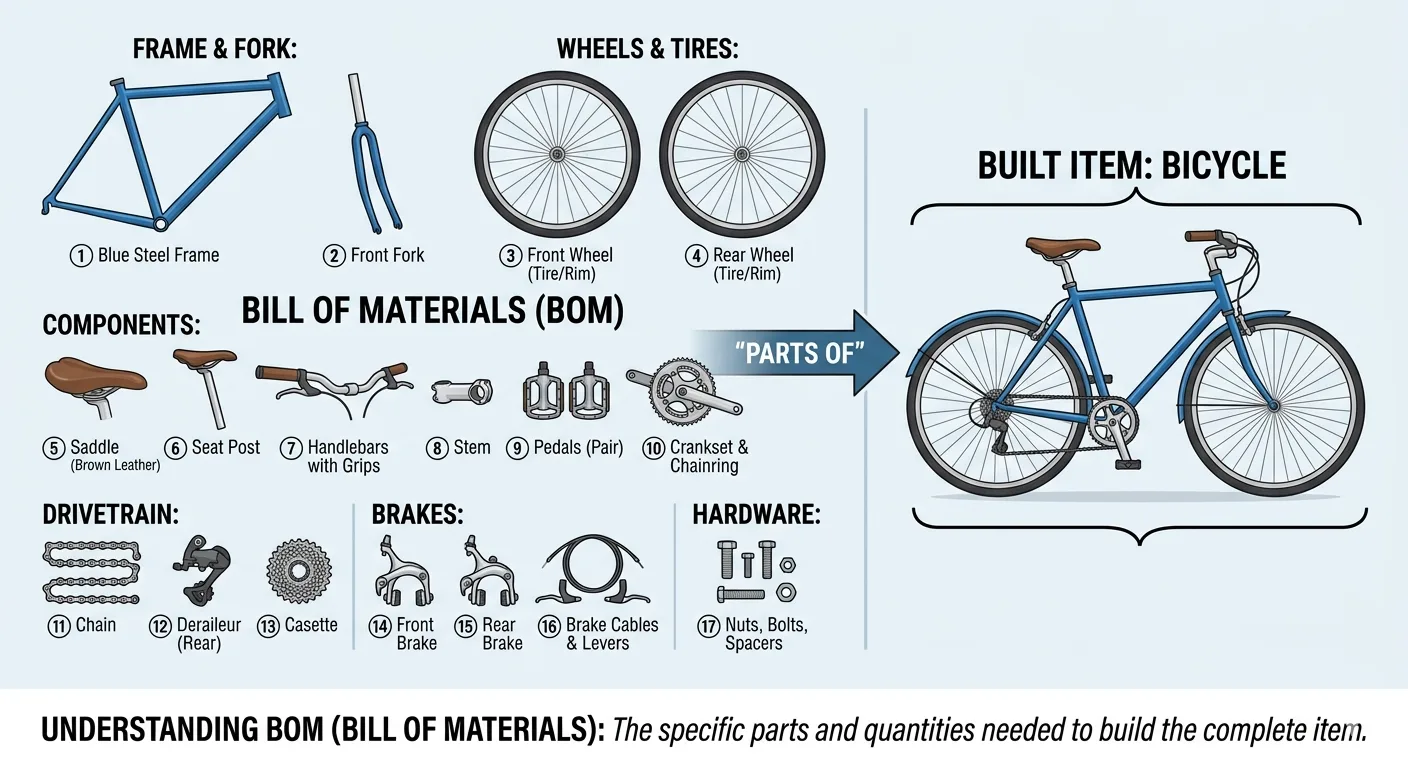
What Is a Bill of Materials (BOM)?
A Bill of Materials (BOM) is a comprehensive, structured list of all the raw materials, components, sub-assemblies, and quantities required to manufacture a finished product. Think of it as the recipe or blueprint for production. This single document serves as the foundational data source for multiple departments, including engineering, procurement, production, and finance, ensuring everyone is working from the same playbook.
An accurate BOM is the central nervous system of a manufacturing operation. It details not just what to use, but how much of it, creating a direct link between design and tangible output. Without a clear and precise BOM, manufacturers face a cascade of costly problems, from incorrect purchasing to production shutdowns.
Why an Accurate Bill of Materials Is Non-Negotiable
Maintaining an inaccurate or out-of-date Bill of Materials isn't a minor inconvenience—it's a direct threat to profitability and efficiency. Inaccurate BOMs can lead to significant planning failures and deviations in product costing. When the foundational recipe is wrong, it triggers a chain reaction of operational failures.
Ensures Accurate Product Costing
Your BOM is the basis for calculating your Cost of Goods Sold (COGS). It details every single component cost, which rolls up to the final cost of the finished product. An inaccurate BOM—listing incorrect quantities or outdated component prices—means your COGS is wrong. This leads to flawed pricing strategies, inaccurate margin analysis, and ultimately, poor financial decision-making.
Streamlines Procurement and Purchasing
Procurement teams rely on the BOM to know exactly what materials to order and in what quantities. An accurate BOM prevents both over-ordering (which ties up cash in excess inventory) and under-ordering (which can halt production entirely). It provides the clarity needed to maintain optimal stock levels and manage supplier relationships effectively.
Prevents Production Delays and Shortages
An incorrect BOM is a leading cause of production line stoppages. If a crucial component is missing from the list, the assembly line will eventually grind to a halt, leading to costly downtime and missed deadlines. Conversely, if the BOM specifies the wrong part, it can lead to rework, scrap, and wasted labor. A study by Siemens found that a single hour of downtime in the automotive industry can cost over $2 million.
Enables Precise Inventory Control
An accurate BOM is fundamental for any inventory tracking system. It allows your inventory management software to automatically deduct the correct components and quantities from stock when a finished good is produced. This process, known as backflushing, is impossible without a reliable BOM, leading to discrepancies between physical and system inventory counts.
Key Components of a Comprehensive BOM
While the specific format can vary, a robust Bill of Materials should always contain several key data points to be effective:
- Part Number: A unique identifier for each component or assembly to prevent confusion.
- Part Name & Description: A clear name and detailed description for each part, helping to distinguish it from similar components.
- Quantity: The exact number of units of a specific part required for a single finished product.
- Unit of Measure (UoM): Defines how the part is measured (e.g., 'each,' 'inches,' 'liters,' 'kilograms'). Consistency here is critical.
- Procurement Type: How the part is acquired (e.g., purchased off-the-shelf, fabricated in-house).
- Reference Designators: For electronics, these specify where the part fits on the printed circuit board (PCB).
- Notes: A field for any additional essential information, such as supplier preferences or handling instructions.
Single-Level vs. Multi-Level BOMs
Bills of Materials are generally structured in one of two ways, depending on the complexity of the product.
Single-Level BOM
A single-level BOM is a simple list of all the components required to make a product. It's like a basic shopping list and doesn't show the relationship between assemblies and their sub-components. This structure is suitable for very simple products with few parts and no sub-assemblies.
Example: A Simple Wooden Stool
- 1x Seat Top
- 4x Legs
- 8x Screws
Multi-Level BOM
A multi-level BOM, also known as an indented BOM, shows the hierarchical parent-child relationships between components, sub-assemblies, and the final product. This structure is essential for complex products. It provides a detailed breakdown that shows how sub-assemblies are constructed before they are used in the next level of assembly.
Example: A Bicycle
- Level 1: Bicycle (Finished Product)
- Level 2: Frame Assembly
- Level 2: Wheel Assembly (Quantity: 2)
- Level 3: Tire
- Level 3: Rim
- Level 3: Hub
- Level 3: Spokes (Quantity: 36)
- Level 2: Drivetrain Assembly
- Level 3: Crankset
- Level 3: Chain
- Level 3: Pedals (Quantity: 2)
For any manufacturer dealing with products of moderate to high complexity, a multi-level BOM is the only way to manage production effectively.
How an ERP Centralizes Your Bill of Materials Management
Managing BOMs in spreadsheets is a recipe for disaster. It creates version control nightmares, data silos, and a high risk of manual entry errors. A modern cloud ERP system like ianaiERP is designed to be the single source of truth for your entire operation, with the Bill of Materials at its core.
An ERP system integrates your BOMs with every other critical function of your business:
- Inventory Management: When a production order is created, the ERP instantly checks component availability based on the BOM and allocates stock.
- Procurement: If components are low, the ERP can automatically generate purchase orders to prevent shortages.
- Production Planning: The BOM informs production scheduling, ensuring all necessary parts are available for each stage of the manufacturing process.
- Costing: The ERP uses the BOM to automatically calculate production costs in real-time, providing an accurate view of product margins as material prices fluctuate.
By centralizing BOM data, an ERP eliminates guesswork, reduces errors, and provides the visibility needed to run a lean, efficient, and profitable manufacturing operation.
Your Bill of Materials is more than a parts list; it's the blueprint for your success. To learn how ianaiERP can help you build, manage, and scale your BOMs with confidence, explore our features in the User Guide or contact us for a consultation.