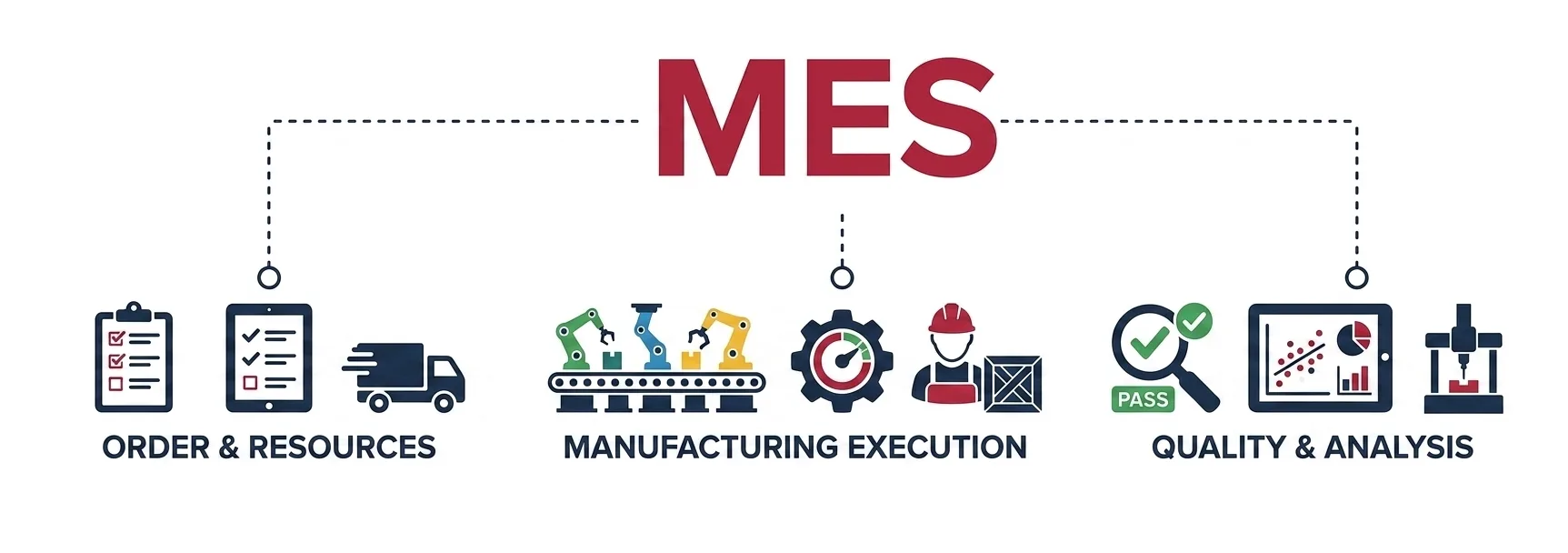
What is a Manufacturing Execution System (MES)?
A Manufacturing Execution System (MES) is the digital command center for your shop floor. It bridges the critical gap between high-level business planning in your Enterprise Resource Planning (ERP) system and the real-time, physical processes of turning raw materials into finished goods. While your ERP handles the 'what' and 'why' of production (orders, inventory, financials), the MES manages the 'how' and 'when' on the factory floor, providing live visibility and control over every machine, operator, and work order.
This guide explores the essential criteria for selecting a modern MES, reviews the leading platforms for 2026, and looks at the trends shaping the future of shop floor management. The goal is to equip you with the knowledge to choose a system that not only optimizes production today but also scales for the challenges of tomorrow.
Key MES Features for Modern Manufacturers
A modern MES is more than just a data collection tool; it's an active, intelligent system that drives efficiency and quality. When evaluating options, prioritize platforms that deliver on these core capabilities:
- Real-Time Data Collection & Monitoring: The system should connect directly to machines, sensors, and operators to capture production data as it happens. This provides immediate insight into performance, downtime, and quality deviations.
- Production Scheduling & Dispatching: An effective MES translates ERP production plans into detailed, actionable schedules for the shop floor, optimizing resource allocation and managing work order dispatch.
- Work-in-Progress (WIP) Tracking: Track jobs, materials, and sub-assemblies in real time as they move through the production cycle. This granular visibility is crucial for identifying bottlenecks and managing flow.
- Quality Management: Integrate quality checks directly into the production workflow. A strong MES enforces quality standards, captures inspection data, and manages non-conformance issues in real time.
- Traceability and Genealogy: Maintain a complete digital history of every product, including the specific raw material lots, equipment, and operators involved. This is non-negotiable for regulated industries and essential for rapid root-cause analysis.
- Performance Analytics (OEE): The system should automatically calculate and visualize key performance indicators (KPIs) like Overall Equipment Effectiveness (OEE), helping you understand and improve asset utilization.
Top Manufacturing Execution Systems for 2026
The MES market is diverse, with solutions ranging from enterprise-focused platforms to nimble, cloud-native tools. Here’s a look at some of the top players shaping the industry.
For Large, Complex Operations
- Siemens Opcenter: A leader in the MES space, Siemens offers a comprehensive suite for Manufacturing Operations Management (MOM). It excels in complex discrete and process manufacturing, with deep integration into Siemens' broader digital twin and PLM ecosystem.
- Dassault Systèmes DELMIA Apriso: Focused on global manufacturing operations, DELMIA Apriso provides a unified platform to standardize processes across multiple sites, making it a strong choice for large enterprises seeking global visibility and control.
- Rockwell Automation (Plex): Plex Smart Manufacturing Platform combines MES, ERP, and QMS in a single cloud-based solution. It's well-regarded in industries like automotive and food & beverage for its comprehensive shop floor to top floor integration.
For High-Tech & Regulated Industries
- Critical Manufacturing MES: This system is tailored for high-tech industries like semiconductors, electronics, and medical devices. It offers advanced process control, equipment integration, and traceability features designed for complex, high-stakes environments.
- iBASEt Digital Operations Suite: iBASEt focuses on complex discrete manufacturing in regulated sectors like aerospace, defense, and medical devices. It provides a paperless, quality-driven platform that unifies MES, QMS, and MRO (Maintenance, Repair, and Overhaul).
For Agility and Ease of Use
- Tulip: A modern, cloud-native platform, Tulip empowers frontline operations with a low-code app builder. This flexibility allows manufacturers to quickly create custom applications for work instructions, quality checks, and machine monitoring without extensive IT resources, making it popular for its user-friendliness.
- Prodsmart (by Autodesk): A lightweight, mobile-friendly MES, Prodsmart is designed for small to mid-sized manufacturers seeking simplicity and rapid implementation. It focuses on core functionalities like real-time production tracking and performance analytics.
The Rise of the AI-Native ERP: A Modern Alternative
While traditional MES solutions focus exclusively on the shop floor, a new trend is emerging: AI-native ERPs with built-in, intuitive manufacturing execution capabilities. For many small-to-midsize manufacturers, the complexity and cost of implementing a separate, dedicated MES can be prohibitive. The integration between ERP and MES, while critical, can also become a significant point of failure or friction.
This is where platforms like ianaiERP are changing the game. Instead of bolting on a separate system, ianaiERP builds shop floor control directly into its unified cloud platform. This approach offers several distinct advantages:
- Seamless Integration: By design, there is no gap between planning and execution. Work orders created in the ERP are instantly available on the shop floor with all necessary data, from the Bill of Materials to work instructions.
- Intuitive User Experience: Modern ERPs are built with user experience at the forefront. This means operators can use tablets or other mobile devices with simple, clean interfaces, reducing training time and increasing adoption.
- AI-Powered Insights: AI is no longer just a buzzword; it's a core competency. AI-native platforms can deliver predictive maintenance alerts, optimize production schedules in real time, and perform advanced quality control by analyzing production data patterns. This proactive capability moves operations from a reactive to a predictive model.
- Lower Total Cost of Ownership: A single, unified platform eliminates the need for multiple software licenses, complex integration projects, and separate maintenance contracts, making advanced manufacturing capabilities more accessible.
For growing manufacturers who need agility and deep operational intelligence without the overhead of a multi-system architecture, an AI-native ERP with embedded execution functions presents a compelling and future-proof alternative to a traditional MES.
Ready to see how a modern, all-in-one platform can transform your operations? Explore our user guides or contact us to learn more about ianaiERP's approach to manufacturing excellence.