The Double-Edged Sword of Customer Choice
Offering customers the power to customize products is a major competitive advantage. But for operations and supply chain leaders, this flexibility often creates a cascade of complexity. This strategy, known as configurable manufacturing or configure-to-order (CTO), allows customers to select from a predefined set of options to build their ideal product. While it boosts customer satisfaction and reduces finished goods inventory, it can wreak havoc on your internal processes.
This post explores the operational hurdles of configurable manufacturing and explains how a modern Enterprise Resource Planning (ERP) system with an integrated product configurator is essential for managing the complexity, reducing errors, and scaling your business profitably.
What is Configurable Manufacturing?
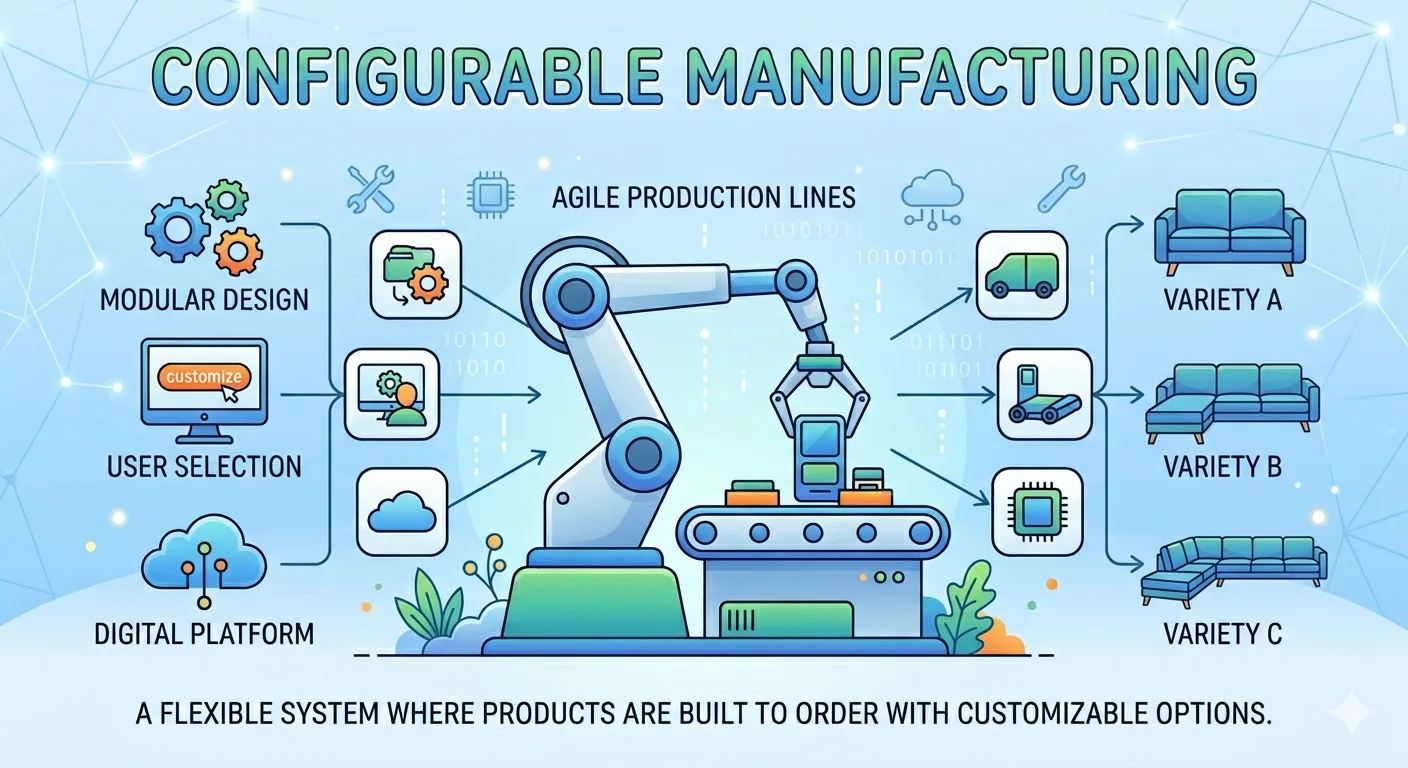
Configurable manufacturing is a production strategy where products are assembled only after a customer selects their preferred features from a menu of options. Think of building a new car online—you choose the engine, color, interior trim, and tech package. The manufacturer doesn't build the car until your specific configuration is ordered. This approach is a hybrid model, sitting between Make-to-Stock (MTS), where identical products are made in advance, and Make-to-Order (MTO), where a product might be designed from scratch.
This model is common in industries producing complex products with many potential variations, such as:
- Industrial machinery and equipment
- HVAC systems
- Modular furniture
- Electronics and computer hardware
- Specialty vehicles
While the customer sees a simple selection process, the backend reality for the manufacturer is anything but. Each unique combination represents a new product variation with its own specific material and production requirements.
The Operational Challenges of Configurable Manufacturing
Without the right systems, a configure-to-order model creates significant friction across the organization. The core challenge is managing an explosion of data and process variations that manual systems and spreadsheets simply cannot handle.
1. Bill of Materials (BOM) Explosion
For every unique product configuration, you need a unique Bill of Materials (BOM). If a product has just a handful of options, the number of possible BOMs can quickly spiral into the thousands or even millions. Creating and managing a static BOM for every single permutation is not just impractical; it's a recipe for errors, outdated information, and immense administrative overhead.
2. Inaccurate Quoting and Pricing
When a sales rep is building a quote, they need to know the precise cost of the requested configuration. This requires accurately summing the costs of all necessary components and labor steps. Doing this manually is slow and highly prone to error. Under-pricing erodes margins, while over-pricing can lose the sale entirely. Customers expect fast, accurate quotes, and delays in this process can be costly.
3. Inventory Mismanagement
Forecasting for configurable products is notoriously difficult. You aren't forecasting finished goods, but rather the demand for individual components and options. This creates a delicate balancing act. Stocking too many niche components leads to high carrying costs and potential obsolescence. Stocking too few of a popular option can lead to long lead times and unhappy customers. Without a clear, real-time view of component demand linked to sales configurations, optimizing inventory levels is nearly impossible.
4. Production Errors and Delays
Once a custom order is placed, that specific configuration must be translated into a precise set of instructions for the shop floor. Manually creating production orders, work instructions, and routings for each unique build introduces a high risk of miscommunication and error. Using the wrong component or performing an incorrect assembly step leads to rework, scrap, and shipment delays, ultimately damaging both your bottom line and your reputation.
How ERP Transforms Configurable Manufacturing
A cloud ERP system designed for manufacturers is the key to taming the chaos. The secret weapon is a built-in Product Configurator, a rules-based tool that connects sales, engineering, and production within a single, unified platform.
Instead of drowning in complexity, an ERP with a product configurator allows you to manage the underlying rules of your products, letting the system handle the specifics of each order.
Dynamic BOM and Routing Generation
This is the core of the solution. A product configurator doesn't store thousands of static BOMs. Instead, it holds a master list of all possible components and a set of rules defining how they can be combined. When a user selects a set of options for an order, the ERP dynamically generates the precise BOM and production routing for that specific configuration in real-time. This ensures 100% accuracy and eliminates the need for manual BOM creation entirely.
Automated and Accurate Quoting (CPQ)
Modern ERP configurators are often part of a Configure, Price, Quote (CPQ) system. As the sales team or even the customer makes selections, the system instantly calculates the price based on the real costs of the materials and labor defined in the ERP. It prevents invalid combinations, ensures all required components are included, and delivers a professional, accurate quote in minutes, not hours. This drastically shortens the sales cycle and improves the customer experience.
Centralized Data for a Single Source of Truth
By integrating the configuration process directly into the ERP, every department works from the same live data.
- Sales can create valid, profitable quotes without deep technical knowledge.
- Engineering maintains one set of master data and rules, rather than countless individual documents.
- Procurement has a clear, demand-driven view of which components to order.
- Production receives an error-free work order with the exact BOM and routing needed to build the product correctly the first time.
This single source of truth eliminates data silos, reduces manual entry, and ensures seamless communication from order to fulfillment.
Getting Started with Configurable Manufacturing in Your ERP
For manufacturers and brands struggling with the complexity of product customization, moving past spreadsheets and disconnected software is the first critical step. The ability to offer tailored products without sacrificing operational efficiency is no longer a luxury—it's a competitive necessity. An integrated cloud ERP platform provides the control and automation needed to make configurable manufacturing a profitable, scalable part of your business.
Ready to see how a modern ERP can streamline your operations? Explore our resources or contact us to speak with an expert about your specific manufacturing challenges.