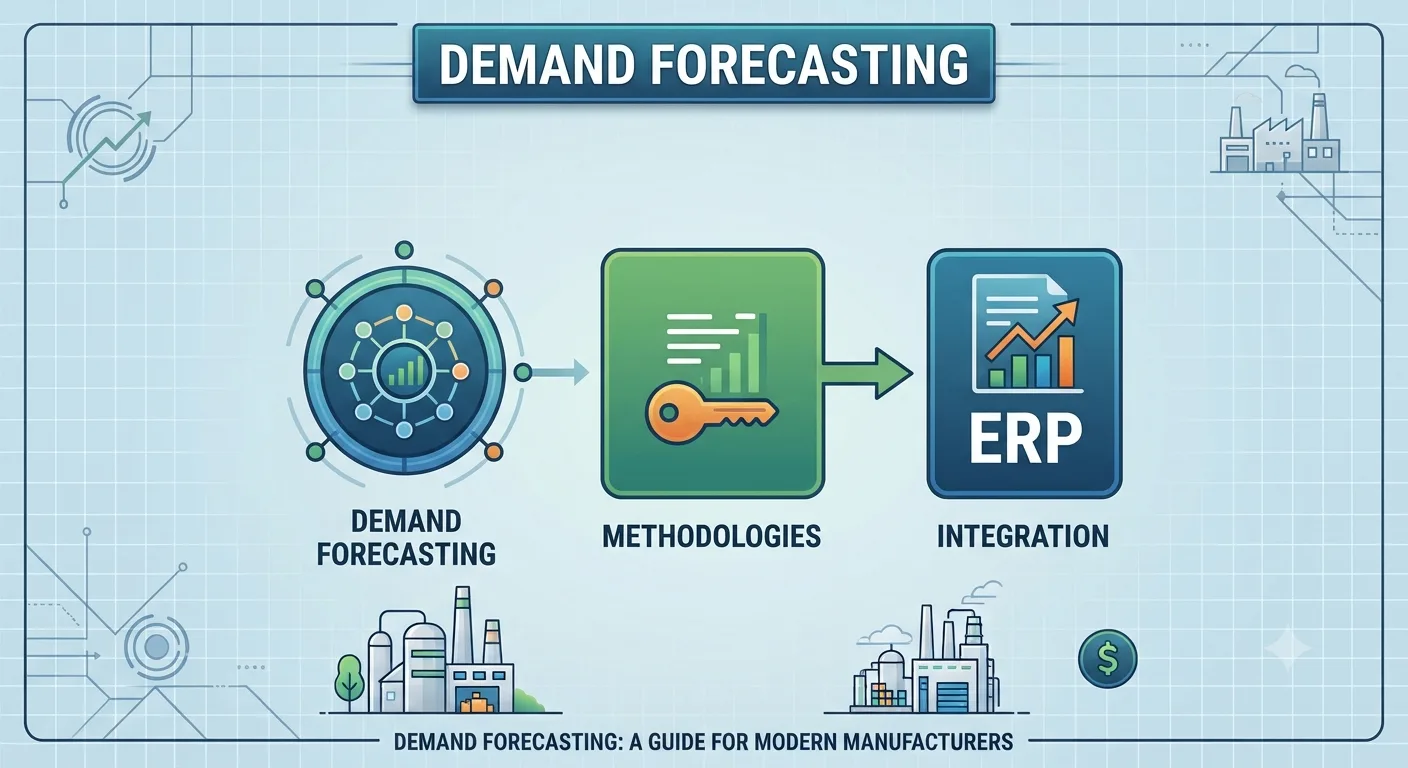
What Is Demand Forecasting in Manufacturing?
Demand forecasting is the process of using historical data, market trends, and statistical analysis to predict future customer demand for products. It is the critical first step in a chain of decisions that affects nearly every aspect of a business—from the raw materials purchased to production schedules on the shop floor. Accurate forecasting helps prevent two costly scenarios: stockouts, which can lead to lost sales and dissatisfied customers, and overstocking, which ties up cash and increases storage costs.
Effective forecasting shifts operations from reactive to proactive. Instead of scrambling to fulfill unexpected orders or discounting excess inventory, businesses can align inventory, production, and financial resources with a data-driven plan. This guide explores the core methods of demand forecasting and explains why a modern ERP system is essential for improving forecasting accuracy.
Key Demand Forecasting Methods
Forecasting methods generally fall into two categories: qualitative and quantitative. The best approach often involves a blend of both, depending on your product, market, and the availability of data.
Qualitative Methods
Qualitative forecasting relies on expert judgment rather than historical data or statistical models. It is most useful when historical data is limited, such as during a new product launch or when entering a new market.
- Expert Opinion: Gathering insights from key stakeholders across your business, including sales, marketing, and executive leadership.
- Delphi Method: A structured technique that involves polling a panel of experts through multiple rounds of anonymous questionnaires. The goal is to reach a group consensus without the influence of group dynamics.
- Market Research: Directly surveying customers about their purchasing intentions or conducting market analysis to understand broader consumer behavior and trends.
Quantitative Methods
Quantitative forecasting uses historical data and mathematical models to predict future demand. It is the most common approach for established products with a proven sales history.
- Time Series Analysis: This method assumes that past demand is the best predictor of future demand. It analyzes historical data to identify patterns such as trends and seasonality. Common time series models include:
- Moving Averages: Smooth out short-term fluctuations to reveal the underlying trend.
- Exponential Smoothing: A more advanced forecasting technique that places greater weight on recent data.
- Causal Models: This approach identifies cause-and-effect relationships between demand and external variables. For example, a causal model may correlate sales with factors such as marketing spend, promotions, competitor pricing, and economic indicators.
The Benefits of Accurate Demand Forecasting
Investing in accurate demand forecasting delivers tangible benefits across the organization, improving both operational efficiency and profitability.
- Optimized Inventory Levels: This is the most immediate benefit. By aligning inventory with anticipated demand, businesses can reduce carrying costs associated with excess stock while minimizing the risk of stockouts that lead to lost sales. Research suggests that AI-based forecasting can reduce stockouts by up to 65%.
- Improved Production Scheduling: Reliable forecasts enable more efficient master production schedules and material planning. This leads to better utilization of labor and equipment, reduced overtime costs, and smoother production operations.
- Enhanced Financial Planning: Forecasting provides the foundation for accurate revenue projections and cash flow management. It enables finance teams to budget more effectively for raw materials, labor, and other operational expenses.
- Stronger Supplier Relationships: Reliable long-range forecasts help suppliers better plan their capacity and material procurement. This can lead to improved pricing, more reliable lead times, and stronger collaborative partnerships.
Why Spreadsheets Aren't Enough for Forecasting
Many growing manufacturers begin by managing forecasts in spreadsheets. While effective initially, this approach quickly becomes a liability as the business scales. Spreadsheets are disconnected from real-time data, prone to manual data entry errors, and make cross-functional collaboration between departments difficult.
As product lines expand and market dynamics shift, a static spreadsheet can no longer keep pace. It lacks the capability to run advanced statistical models or automatically integrate real-time sales data, resulting in forecasts that are consistently out of date.
The Role of ERP in Modern Demand Forecasting
Enterprise Resource Planning (ERP) systems serve as the central nervous system of a manufacturing business, making them an ideal platform for demand forecasting.
- A Single Source of Truth: An ERP system centralizes data from across the operation—including sales history, current orders, inventory levels, production data, and procurement—into a single, unified database. This eliminates the data silos and inconsistencies that often impact spreadsheet-based forecasting.
- Advanced Analytics & Automation: Modern ERP systems include built-in forecasting modules that automate complex calculations. They can apply multiple statistical models to historical data, identify seasonality patterns, and generate baseline forecasts with minimal manual effort.
- Seamless Integration with Planning: A forecast is not an isolated number; it is a critical input for other core functions. Within an ERP system, demand forecasts directly support Material Requirements Planning (MRP), production scheduling, and purchasing, ensuring the entire operation stays aligned.
- AI and Machine Learning Capabilities: The next generation of ERP systems incorporates artificial intelligence (AI) to improve forecasting accuracy. Research by McKinsey shows that AI can reduce forecasting errors by 20% to 50%. These systems can analyze large datasets, identify complex patterns, and incorporate external data signals such as economic indicators or weather patterns to produce more accurate and resilient predictions.
By leveraging an ERP system for demand forecasting, businesses can transform a challenging, error-prone task into a strategic capability that drives efficiency and growth.
Ready to move beyond spreadsheets and see how a modern ERP can revolutionize your planning? Learn more about ianaiERP's capabilities in our User Guide or contact us to speak with an expert.