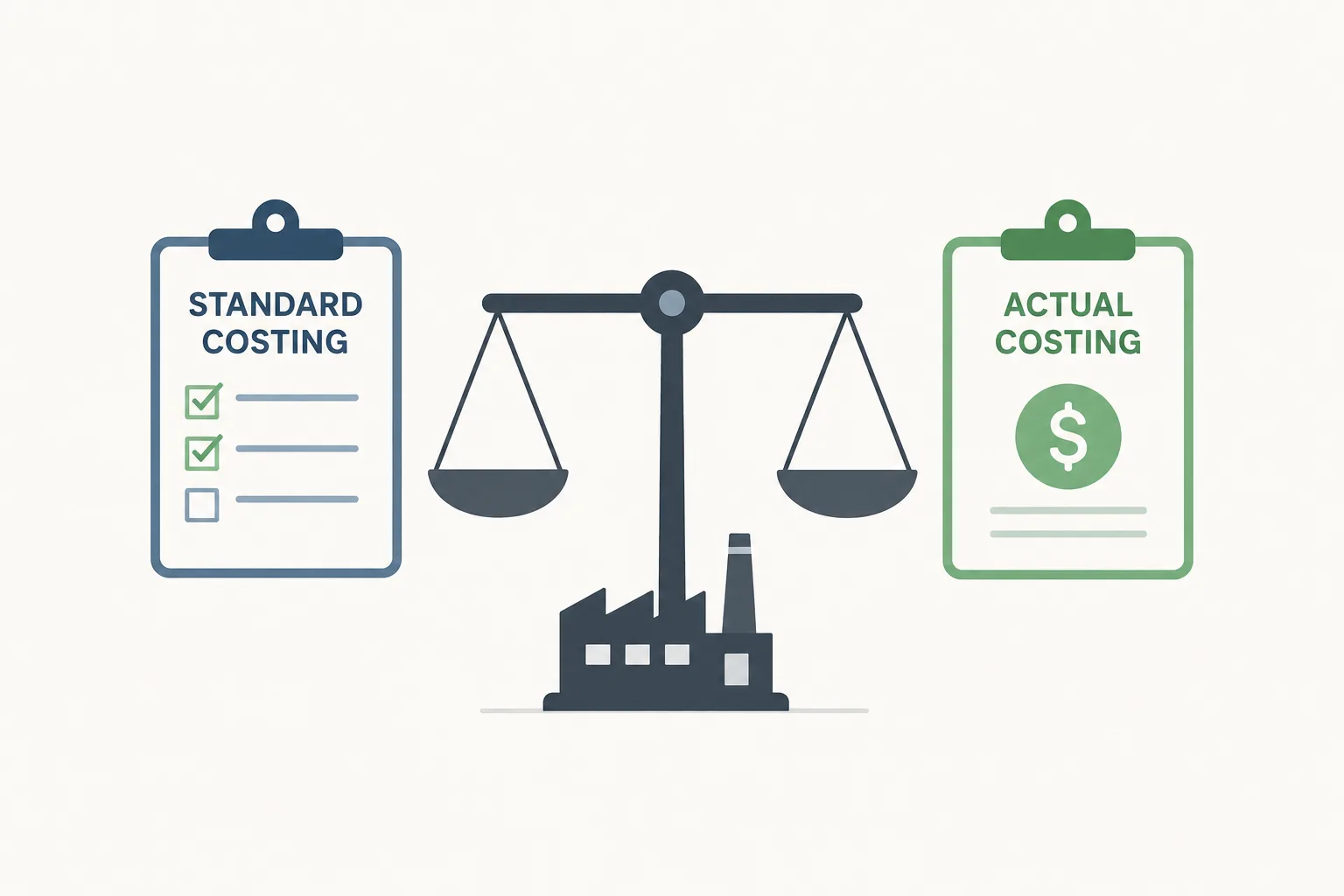
Standard Costing vs. Actual Costing: Choosing the Right Method
How much does it really cost to make your product? Answering that question is fundamental to your profitability, but it's more complex than it sounds. The two primary methods for valuing inventory and cost of goods sold (COGS) in manufacturing are standard costing and actual costing. Choosing the right one—and managing it effectively—has significant implications for your financial reporting, pricing strategies, and operational efficiency.
This guide breaks down the core concepts of standard costing vs. actual costing, explains the critical role of variance analysis, and shows how a modern ERP system provides the control you need to manage either method effectively.
What Is Standard Costing?
Standard costing is a proactive approach where you assign a predetermined or "standard" cost to each component of production: direct materials, direct labor, and manufacturing overhead. These standards are not guesses; they are carefully calculated benchmarks based on historical data, engineering estimates, supplier pricing, and expected efficiency levels.
Think of a standard cost as the budget for producing one unit. For example, a furniture maker might set a standard cost for a chair at $120, broken down as:
- Standard Material Cost: $50 (based on expected wood quantity and price)
- Standard Labor Cost: $40 (based on expected hours and wage rate)
- Standard Overhead Cost: $30 (a predetermined allocation of factory costs like rent and utilities)
Pros and Cons of Standard Costing
- Pros: It provides a stable baseline for pricing, simplifies inventory valuation, and makes budgeting more predictable. By establishing clear benchmarks, it allows for quick identification of when actual costs deviate, enabling timely corrective action.
- Cons: Standards can become outdated, especially in volatile markets where material prices fluctuate. If not updated regularly, the resulting variances can become large and less meaningful as a performance signal.
What Is Actual Costing?
Actual costing is a reactive method that tracks the exact costs incurred during the production process. Instead of using predetermined estimates, this method records the real-time, historical cost of every material consumed, every labor hour worked, and all overhead applied to a specific job or production run.
Using the same chair example, the actual cost might be $127 because:
- Actual Material Cost: $55 (the price of wood increased)
- Actual Labor Cost: $42 (an employee took longer than expected)
- Actual Overhead Cost: $30 (overhead is often applied at a predetermined rate even in actual costing, a hybrid approach called "normal costing")
Pros and Cons of Actual Costing
- Pros: It provides a precise and accurate picture of true production costs for a specific job, which is invaluable for businesses with custom products or volatile input costs.
- Cons: This method is complex and time-consuming, requiring meticulous data collection for every transaction. Costs can fluctuate significantly from one batch to the next, making pricing difficult, and the true final cost is often not known until after a period closes.
The Bridge Between Methods: Variance Analysis
The real power of standard costing comes from variance analysis—the process of comparing standard costs to actual costs and investigating the difference. This is where raw accounting data turns into actionable operational intelligence.
A variance is simply the difference between what you expected to spend (standard) and what you actually spent (actual).
- Unfavorable Variance: Actual cost is higher than standard cost.
- Favorable Variance: Actual cost is lower than standard cost.
Key manufacturing variances include:
- Material Variances: Was the difference due to paying more for materials (Price Variance) or using more material than planned (Usage Variance)?
- Labor Variances: Was the difference due to paying a higher wage (Rate Variance) or workers taking longer than expected (Efficiency Variance)?
By breaking down the total variance, managers can pinpoint whether the purchasing department got a bad deal on materials or if the production floor is struggling with efficiency.
How an ERP System Manages and Automates Costing
Whether you use standard, actual, or a hybrid costing method, manual tracking is nearly impossible in a modern manufacturing environment. The sheer volume of data from purchase orders, inventory movements, labor records, and overhead allocation requires a centralized system.
A modern ERP platform is the essential tool for accurate and timely cost accounting. Here’s how it helps:
- Centralized Data Hub: An ERP serves as the single source of truth, capturing actual costs as they happen—from receiving a supplier invoice to tracking employee hours on a specific work order.
- Standard Cost Management: The system allows you to easily set, manage, and perform cost roll-ups to update standard costs for all your products when input prices or processes change.
- Automated Variance Calculation: An ERP automatically compares actual costs from production against the established standards and calculates the variances in real-time. This eliminates manual spreadsheet work and provides immediate insight.
- Deep Profitability Analysis: By linking cost data directly to production jobs and sales orders, an ERP provides clear visibility into the true margin on every product, customer, and order. This allows you to make data-driven decisions on pricing and product mix.
Ultimately, the debate isn't just about standard vs. actual costing. It's about having a system that provides accurate, timely, and actionable data to control costs and protect your margins. An ERP provides the robust foundation needed to implement your chosen costing strategy effectively.
To learn more about how ianaiERP provides the financial and operational tools to grow your manufacturing business, explore our platform features or contact us to speak with an expert.