Why Your Margins Are Leaking (And How to Fix It)
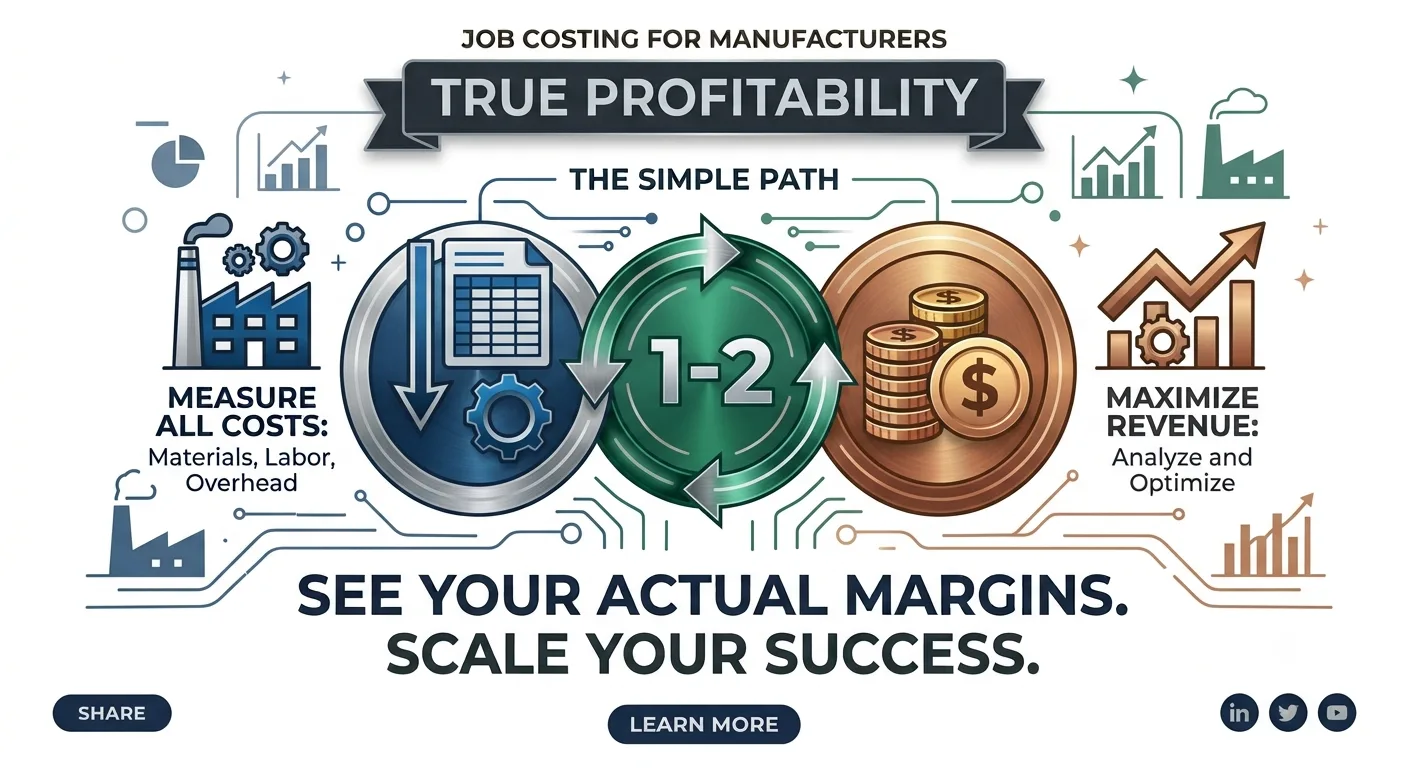
You quoted the job, sourced the materials, and shipped the final product on time. Sales are up, but cash flow feels tight. You have a nagging suspicion that some of your jobs—even the largest ones—aren't as profitable as they should be. This is a common problem for manufacturers, especially those producing custom or varied products. Without a precise way to track costs for each specific production run, you're making critical pricing and business decisions based on guesswork. Job costing is an accounting method that solves this by tracking the actual costs of materials, labor, and overhead for each individual job.
Unlike process costing, which averages costs across large batches of identical items, job costing provides granular visibility. It's designed for make-to-order operations, custom fabricators, and any manufacturers where each order has a unique set of requirements. This guide breaks down how job costing works, why it's essential for profitability, and how a modern ERP platform simplifies the process.
The Anatomy of a Job Cost
At its core, job costing is about accumulating all the costs tied to a specific manufacturing order to determine its true cost. This allows you to see if you're pricing your work correctly and which types of jobs are most profitable. The calculation itself is straightforward, summing three primary cost categories.
Total Job Cost = Direct Materials + Direct Labor + Applied Overhead
Let's explore each component.
Direct Materials
These are all the raw materials and purchased components that are physically part of the final product for a specific job. This includes everything from metal stock and plastic resins to fasteners, wiring, and packaging. Accurate tracking relies on a well-managed Bill of Materials (BOM), which lists every part required. An ERP system automates this by pulling material costs directly from your inventory and purchasing records as they are consumed by a work order.
Direct Labor
Direct labor includes the wages and benefits paid to the employees who are directly involved in producing the goods for that job. This isn't just runtime; it also includes machine setup, quality checks, and any required rework. To calculate this, you track the hours each employee spends on a specific job and multiply it by their fully-loaded hourly rate (which includes payroll taxes and benefits). Relying on base wages alone can understate your true labor cost significantly.
Manufacturing Overhead
This is the most complex component to assign. Manufacturing overhead includes all the indirect costs necessary for production that can't be directly tied to a single job. Examples include:
- Factory rent and utilities
- Equipment depreciation and maintenance
- Indirect labor (e.g., supervisors, material handlers, quality assurance staff)
- Shop supplies and insurance
Since you can't trace these costs directly, you allocate them using a predetermined overhead rate. This is typically calculated by dividing your total estimated annual overhead by an allocation base, such as total direct labor hours or machine hours. For example, if your annual overhead is $500,000 and you expect 10,000 direct labor hours, your predetermined overhead rate is $50 per direct labor hour.
The Strategic Benefits of Accurate Job Costing
Implementing a robust job costing system helps moves your business from reactive approach to strategic one. When you know the true cost of every job, you unlock several key advantages.
1. Precision Pricing and Quoting
With accurate historical cost data, you can stop guessing and start building quotes that guarantee profitability while remaining competitive. You can confidently take on complex custom work, knowing your price covers every contingency. This prevents underpricing that erodes margins and overpricing that loses bids.
2. True Profitability Analysis
Job costing allows you to analyze profitability by job, customer, product line, and even by machine. You might discover that a long-time customer is consistently unprofitable, or that a certain type of product generates much higher margins than you realized. These insights are critical for making informed decisions about where to focus your resources and sales efforts.
3. Improved Cost Control and Efficiency
By comparing estimated costs to actual costs in real time, you can immediately spot variances. Did material costs come in higher than expected? Did a specific operation take longer than planned? This visibility allows you to identify inefficiencies in your production process, reduce waste, and take corrective action before a small issue becomes a major loss.
4. Smarter Resource Allocation
Understanding resource consumption (both labor and machine time) for different types of jobs helps you optimize scheduling and capacity planning. You can make better decisions about staffing levels, equipment upgrades, and supply chain management when you have a clear picture of how resources are being used.
Why Spreadsheets and Manual Tracking Fail
While the concept of job costing is simple, execution can be incredibly challenging without the right tools. Many manufacturers start by using spreadsheets or disconnected accounting software, but these methods quickly become a liability.
- Data Silos: Information is scattered. Purchasing has material costs, production has labor hours, and accounting has overhead figures. Manually consolidating this data is time-consuming and prone to costly errors.
- Lack of Real-Time Insight: By the time you've manually compiled a job cost report, the job may already be complete. You can't intervene to fix a budget overrun that happened weeks ago.
- Complex Record-Keeping: Tracking every material requisition and every minute of labor for dozens of concurrent jobs is a significant administrative burden.
- Inaccurate Overhead Allocation: Simplified, plant-wide overhead rates can distort product costs. A job that's run on an expensive, high-maintenance CNC machine should absorb more overhead costs than a simple manual assembly task.
How an ERP Platform Delivers Reliable Job Costing
A modern, cloud-based ERP system like ianaiERP is designed to solve these challenges. By unifying every aspect of your operation into a single source of truth, it makes accurate job costing an automated, real-time process.
An ERP system connects the dots seamlessly:
- Bills of Materials (BOMs): When a work order is created, the ERP automatically reserves the required materials from inventory and associates their actual cost with the job.
- Shop Floor Data Collection: As employees work on a job, they log their time directly in the system, capturing precise labor costs without manual timesheets.
- Integrated Accounting: The ERP tracks all indirect costs and applies overhead automatically based on predefined rates (by work center, machine hour, or labor hour), ensuring a more accurate allocation.
- Real-Time Dashboards: Managers can monitor job progress and compare estimated versus actual costs at any moment. This allows for immediate intervention if costs are trending over budget.
By automating the accumulation of direct materials, direct labor, and overhead, an ERP transforms job costing from a time-consuming accounting exercise into a powerful strategic tool for driving profitability.
Ready to gain true visibility into your job costs and protect your margins? Explore our resources or contact us to see how ianaiERP can provide the real-time financial oversight your manufacturing business needs. Visit our User Guide or contact our team for a consultation to learn more.