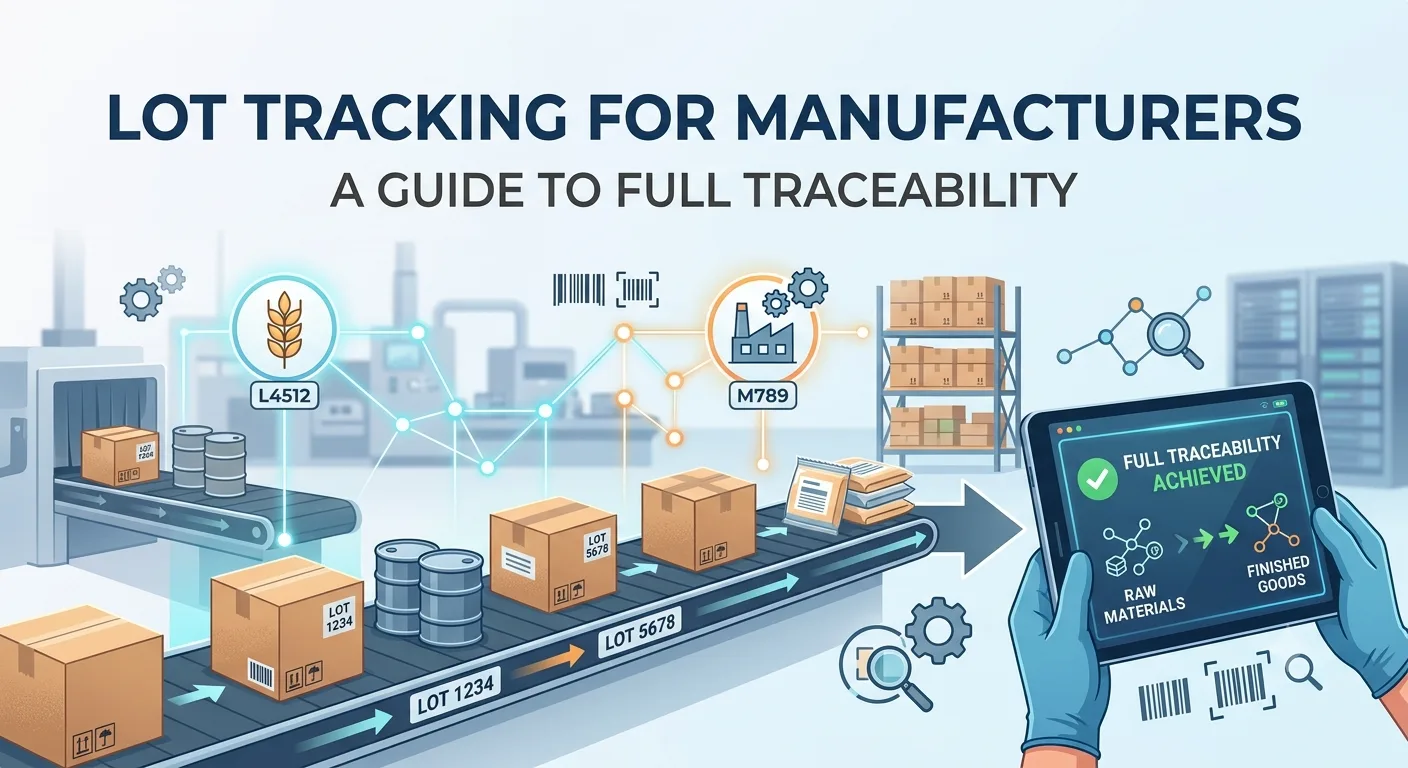
What Is Lot Tracking?
Lot tracking is the process of tracing goods throughout the supply chain using a unique code assigned to a specific batch, or “lot,” of products. This lot number acts as a fingerprint for a group of items manufactured, processed, or packaged together under the same conditions. From the moment raw materials arrive at a facility to the final delivery to customers, lot tracking creates a detailed historical record.
This system allows manufacturers to see the complete journey of a product batch, including which suppliers provided the raw materials, when materials were used in production, what quality checks were performed, and which customers received the finished goods.
It’s important to distinguish lot tracking from serial number tracking. While they may sound similar, they serve different purposes:
- Lot Tracking: One-to-many. A single lot number is assigned to a whole batch of identical items (e.g., 1,000 jars of pasta sauce from a single production run).
- Serial Number Tracking: One-to-one. A unique serial number is assigned to each individual item (e.g., a specific smartphone or vehicle engine).
For many manufacturers, especially in process manufacturing, lot tracking provides the perfect balance of visibility and efficiency.
Why Lot Tracking Is Essential for Modern Manufacturers
In today's complex supply chains, robust traceability is no longer a “nice-to-have”—it is a business necessity. Implementing a strong lot tracking system is critical for risk mitigation, quality assurance, and operational efficiency. The stakes are high, and the benefits are clear.
Regulatory Compliance
For many industries, lot tracking is a regulatory requirement. Regulatory bodies such as the FDA mandate strict traceability standards to help ensure consumer safety. For example, the FDA Food Safety Modernization Act (FSMA) Rule 204 requires detailed record-keeping and traceability documentation for certain foods included on the Food Traceability List (FTL) to accelerate investigations of foodborne illness outbreaks. Companies subject to this rule must be able to provide detailed traceability records to the FDA within 24 hours of a request. Similar regulations exist in industries such as pharmaceuticals, medical devices, cosmetics, and aerospace, where product safety and compliance are critical.
Rapid and Targeted Recalls
A product recall can be a catastrophic event for a brand, with average direct costs estimated at $10 million for food manufacturers alone. Without lot tracking, a single defective component could force a company to recall every product it has ever shipped, leading to significant financial losses and reputational damage.
With precise lot traceability, manufacturers can isolate problems quickly. They can identify exactly which batches of finished goods were made with a specific lot of faulty raw material and determine which customers received them. This enables a swift, targeted recall that minimizes financial impact, protects consumer safety, and preserves brand trust.
Quality Control and Root Cause Analysis
Lot tracking is a powerful tool for quality management. When a quality issue arises—whether identified internally or through a customer complaint—traceability allows manufacturers to work backward and find the source. Manufacturers can trace a defective finished product through the production process to the exact batch of raw materials or specific equipment used. This end-to-end visibility, often called product genealogy, is crucial for effective root cause analysis, helping organizations fix problems permanently and prevent them from recurring.
The High Cost of Manual Lot Tracking
Despite its importance, many growing manufacturers still attempt to manage lot tracking with a patchwork of spreadsheets, paper logs, and disconnected systems. This manual approach is not only inefficient but also creates significant risks. The key challenges include:
- Human Error: Manual data entry is prone to typos, omissions, and misplaced records. A single incorrect digit can break the entire traceability chain, making it unreliable during an audit or recall.
- Lack of Real-Time Visibility: Paper- and spreadsheet-based systems are often outdated. By the time data is entered, inventory may have moved, products may have shipped, and the information may no longer accurately reflect current operations. This makes proactive decision-making difficult.
- Inefficiency and Wasted Time: Manually searching through paper records or multiple spreadsheets to trace a lot during a recall is a slow, stressful, and labor-intensive process. The time lost is critical when consumer safety is at risk.
- Disconnected Data Silos: When receiving, production, and shipping rely on separate systems, there is no single source of truth. This makes it difficult to create a seamless, end-to-end history of a product lot, leading to gaps in compliance and quality control.
How an ERP Automates Lot Tracking and Ensures Traceability
Enterprise Resource Planning (ERP) software is the foundation for modern, automated lot tracking. An ERP system integrates all aspects of operations into a single, unified platform, creating a seamless digital thread that follows every material and product from beginning to end.
Here’s how an ERP system transforms lot tracking and traceability at each stage:
1. Receiving Raw Materials
Traceability begins the moment materials arrive. With an ERP system, manufacturers can scan incoming shipments and assign a unique internal lot number to each batch of raw materials. This lot number is digitally linked to the supplier’s lot number, purchase order, and receipt date, creating the first link in the traceability chain.
2. Production and WIP
As raw materials move into production, the ERP system tracks their consumption. When a work order is created, the system records which specific component lots are used to create a new batch of finished goods. This maintains the crucial parent-child relationship between raw materials and the final product. You can easily manage your work in process inventory with full lot-level visibility.
3. Finished Goods and Inventory
Once a production run is complete, the ERP system assigns a new lot number to the batch of finished goods. This lot record contains the complete history of all raw material lots used in production. The system then tracks the movement of finished goods throughout the warehouse, ensuring manufacturers always know where specific lots are stored.
4. Shipping and Fulfillment
During the fulfillment process, the ERP system records which lot numbers are picked, packed, and shipped to each customer. This final link completes the end-to-end traceability chain. If a customer reports an issue, manufacturers can quickly identify the exact lot number associated with their order and determine the product history.
5. Instant, Bidirectional Reporting
The ultimate benefit of an ERP system is the ability to generate instant traceability reports. With a few clicks, manufacturers can perform:
- Forward Traceability: Start with a raw material lot and identify every finished product it was used in and every customer who received it.
- Backward Traceability: Start with a finished goods lot number and trace it back to identify every raw material, production step, and quality check involved.
This bidirectional traceability capability ensures manufacturers can respond to any inquiry—from a regulator, supplier, or customer—with speed and confidence.
Don’t let manual processes put your business at risk. A modern ERP system with integrated lot tracking provides the real-time traceability needed to ensure compliance, protect customers, and build a resilient brand. To see how ianaiERP can help you achieve full traceability, explore our platform features in the user guide or contact us for a consultation.