What Is Material Requirements Planning (MRP)?
For any manufacturer, the daily operation is a complex balancing act. Running out of a critical component can halt an entire production line, leading to costly delays and unhappy customers. On the other hand, holding too much inventory ties up cash and warehouse space. Material Requirements Planning (MRP) is the system designed to solve this exact problem. It's the engine that powers an efficient production scheduling.
At its core, MRP is a system for production planning, scheduling, and inventory control. It answers three critical questions for every product you manufacture:
- What materials and components are needed?
- How many of each are needed?
- When are they needed to meet the production schedule?
By systematically calculating precise requirements, MRP ensures that materials arrive just in time for production, minimizing waste and maximizing efficiency. Modern ERP platforms have this powerful MRP functionality built in, integrating it with all other aspects of the business for seamless planning.
How an MRP System Works
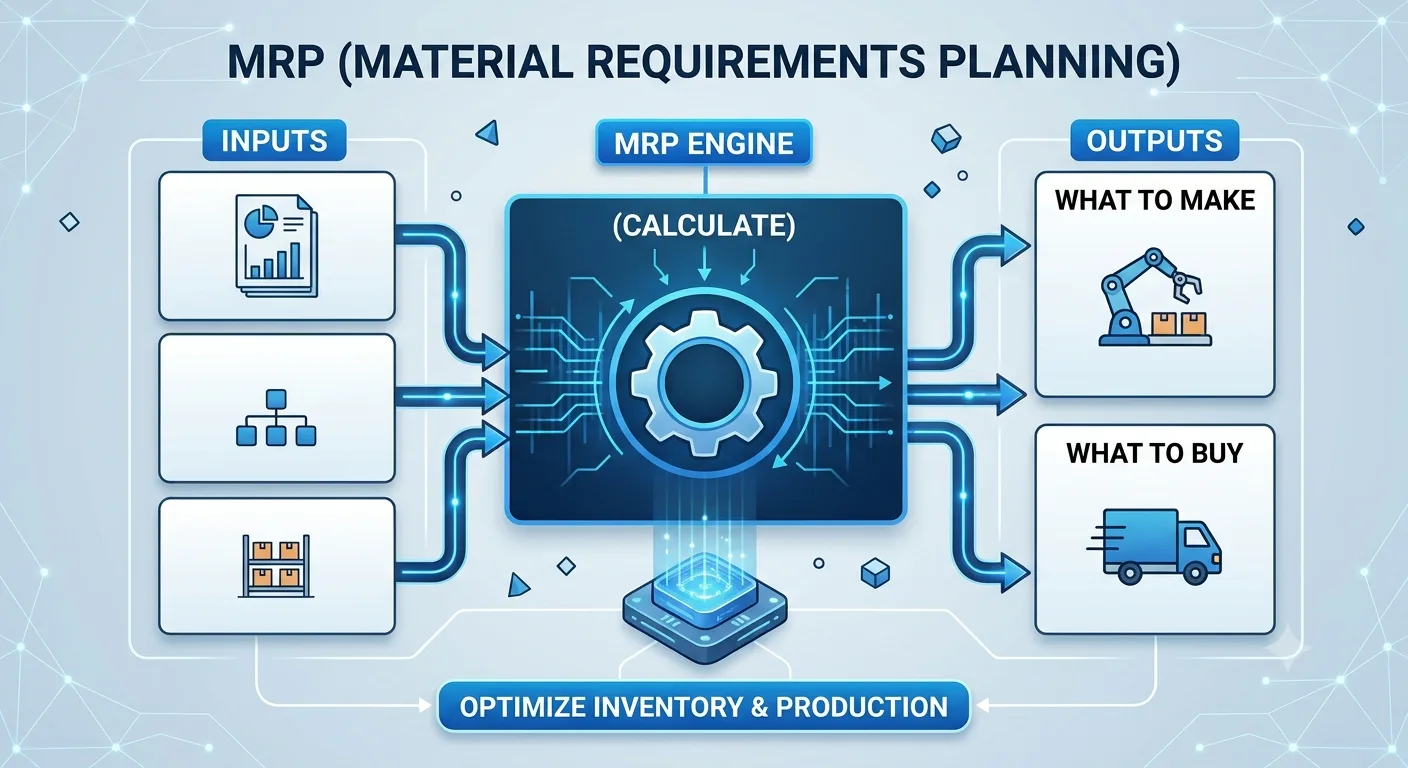
An MRP system doesn't guess; it calculates. It works by processing information from three critical data inputs to generate a clear action plan.
Input 1: Master Production Schedule (MPS)
The MPS dictates the top-level production plan. It details which finished products need to be manufactured, in what quantities, and by what dates. The MPS is derived from a combination of firm customer orders and demand forecasts, creating a clear picture of what your business needs to produce to satisfy the market.
Input 2: Bill of Materials (BOM)
The Bill of Materials (BOM) is a detailed, hierarchical list of all the raw materials, sub-assemblies, and components required to produce one unit of a finished product. The MRP system "explodes" the BOM for each item in the MPS to determine the gross quantity of every single component required for the entire production run. You can learn more about creating an accurate Bill of Materials in our foundational guide.
Input 3: Inventory Status Records
This input provides a real-time snapshot of all inventory. It tells the MRP system what you already have on hand, including raw materials and work-in-progress (WIP) items. It also includes data on scheduled receipts (incoming purchase orders) and lead times for each component. Accurate inventory data is absolutely essential for an MRP system to function correctly.
With these three inputs, the MRP system calculates the net requirements for each component by subtracting available inventory from the gross requirements. It then creates a time-phased schedule, generating purchase order recommendations for materials you need to buy and work orders for sub-assemblies you need to make, all timed perfectly to meet the master production schedule.
The Core Benefits of Integrating MRP into Your ERP
When MRP is a core component of your ERP system, its benefits extend across the entire organization, from the shop floor to the finance department.
- Optimized Inventory Levels: MRP is designed to maintain the lowest possible inventory levels without risking stockouts. This directly reduces inventory carrying costs—such as storage, insurance, and obsolescence—freeing up cash flow for other areas of the business.
- Fewer Production Delays: By ensuring all necessary materials are available exactly when needed, MRP helps prevent shortages that cause production stoppages. This leads to smoother workflows, less downtime, and greater manufacturing efficiency.
- Improved Scheduling and Efficiency: With a reliable flow of materials, you can create more accurate and achievable production schedules. Managers can better allocate resources, including labor and machinery, to maximize throughput and meet delivery deadlines.
- Data-Driven Purchasing: MRP automates purchase recommendations based on real demand and supplier lead times. This empowers your procurement team to make smarter, more economical purchasing decisions, avoid costly rush orders, and build better relationships with suppliers.
- Enhanced Customer Satisfaction: Reliable production planning translates directly to reliable delivery times. By consistently meeting or beating delivery deadlines, you build trust and improve customer satisfaction.
MRP vs. MRP II vs. ERP: Understanding the Evolution
The acronyms in manufacturing technology can be confusing, but they represent a clear evolution of planning systems.
- MRP (Material Requirements Planning): The original system, developed in the 1970s, focused exclusively on managing materials and inventory for production.
- MRP II (Manufacturing Resource Planning): An evolution in the 1980s, MRP II expanded on the core of MRP to include other manufacturing resources. It integrated capacity planning (machines and labor), shop floor control, and financial functions like budgeting.
- ERP (Enterprise Resource Planning): This is the modern, all-encompassing system. An ERP integrates all the functions of MRP II and extends them across the entire enterprise. It connects manufacturing with finance, sales (CRM), human resources, and supply chain management into a single, unified database. Today, robust MRP functionality is considered a foundational module within any true manufacturing ERP system.
Is Your Business Ready for a Modern MRP System?
If your team is constantly firefighting production issues, it might be time to move beyond spreadsheets and manual planning. Ask yourself these questions:
- Are material shortages and surprise stockouts a common cause of production delays?
- Is excess or obsolete inventory tying up significant working capital?
- Do you rely on complex, error-prone spreadsheets to plan purchasing and production?
- Is it difficult to get a clear, real-time picture of your inventory levels and production status?
If you answered yes to any of these, implementing an ERP with a powerful, integrated MRP module can provide the control and visibility you need to scale efficiently.
A modern MRP system eliminates guesswork, replacing it with data-driven precision. By ensuring the right materials are in the right place at the right time, you can cut costs, improve efficiency, and deliver for your customers consistently.
Ready to see how a modern ERP can transform your production planning? Explore our user guide to learn more or contact us to speak with an expert about your specific needs.